

Stay Ahead with Regulatory Insights
Timely updates, expert analysis, and practical guidance on global chemical compliance.
Welcome to the Regulatory News Portal
Stay ahead of the chemical compliance curve with my regularly updated news and information center. As a Canadian regulatory specialist with extensive global expertise, I curate this resource to deliver timely updates, practical guidance, and expert analysis on evolving chemical regulations. Here, you’ll find regulatory changes, implementation timelines, compliance strategies, and industry trends—focused on Canadian requirements while covering North American and European developments. This page supports informed decisions and helps transform compliance challenges into strategic advantages.

The Latest News

The Future of Chemical Compliance: Navigating the 2025-2026 Regulatory Transformation
As global chemical regulations like EU CLP and UK REACH undergo significant transformations, staying ahead of "Compliance" is no longer optional. Discover the critical updates and strategic steps your business must take to navigate the complex world of chemical safety and market access in 2025 and beyond.

Why Global Chemical Regulatory Strategy is the Most Critical Investment for Manufacturers in 2026
ChemicalCompliance.Online offers comprehensive regulatory strategy services, ensuring businesses navigate complex global chemical safety regulations with precision. Learn how a strategic approach to compliance can accelerate market access, reduce risks, and enhance global competitiveness.

The Unseen Cost of Chemical Non‑Compliance — And How ChemicalCompliance.Online Helps Businesses Thrive Globally
ChemicalCompliance.Online offers expert regulatory compliance solutions, helping businesses navigate complex global chemical safety laws, create accurate documentation, and achieve seamless market access. Learn how strategic compliance drives efficiency, reduces operational risk, and builds brand trust.

GHS Revision 11
United Nations Releases GHS Revision 11
The United Nations has just released Revision 11 of the GHS (September 12, 2025). You can access the PDF versions in French, English, and Spanish on the website link below.


Introducing our publication "The Regulatory Secrets"
I'm pleased to launch this dedicated space for sharing critical regulatory information with my clients and industry colleagues. After years of helping companies navigate the complexities of chemical compliance, particularly within Canadian frameworks, I recognized the need for accessible, timely insights on regulatory developments. This publication will deliver expert analysis on emerging regulations, compliance strategies, and industry best practices—information you can trust from a Canadian consultant with extensive experience in both domestic and international chemical regulatory landscapes. I invite you to frequent this page for regular updates designed to help you stay compliant while turning regulatory knowledge into a competitive advantage.
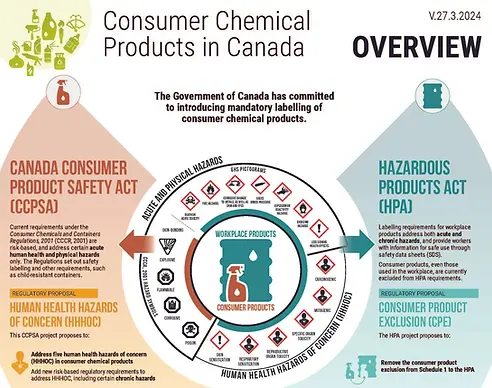
Consumer Chemical Products in Canada
The Government of Canada has committed to introducing mandatory labelling of consumer chemical products.
Canada Consumer Product Safety Act (CCPSA)
The Consumer Product Safety Program at Health Canada is responsible for the administration and enforcement of the CCPSA (or the Act) and its regulations.
The purpose of the CCPSA is to protect the public by addressing or preventing dangers to human health or safety that are posed by consumer products in Canada.
The Act sets out a general prohibition on consumer products that are a danger to human health or safety. The Act includes several product specificregulations.
Consumer products subject to the CCPSA and its regulations are those that may reasonably be expected to be obtained by an individual to be used for non-commercial purposes.
Issues Cited
Consumer products regulated under the Canada Consumer Product Safety Act (CCPSA) are excluded from the requirements of the Hazardous Products Act (HPA).
Some stakeholders have expressed concerns with the exclusion of consumer products under the HPA, including:
Consumer products are increasingly used in the workplace without adequate hazard information for workers to use, handle or store these products safely.
Current requirements under the HPA are not sufficient to inform workers of hazards posed by consumer products in workplace settings where these products could be used in higher frequency.